
📋 Table of Contents
- Why You May Need to Appeal Your Property Value
- Understanding Ross County Property Assessment
- Step 1 – Check Your Current Assessed Value
- Step 2 – Determine Valid Grounds for Appeal
- Step 3 – Gather Your Evidence
- Step 4 – File Your Appeal (Online & In-Person)
- Step 5 – Attend Your Board of Revision Hearing
- Step 6 – What Happens After the Decision
- Should You Hire a Fair Appeal Property Tax Company?
- Ross County Auditor, Recorder & Related Resources
- Frequently Asked Questions
Why You May Need to Appeal Your Property Value in Ross County
Every year, thousands of Ross County homeowners pay more in property taxes than they legally should — simply because they never questioned their assessed property value. If your home has been over-assessed by the Ross County Auditor, you have the legal right to challenge that valuation through a formal appeal process.
Property taxes in Ross County are calculated based on the auditor’s assessed value of your home, which is typically set at 35% of its estimated market value. If the auditor’s estimate of your home’s market value is too high — perhaps because the housing market has softened, your home has structural issues, or there was simply an error — you are overpaying on your Ross County property tax bill every single year until the assessment is corrected.
The appeal process — officially called filing a complaint with the Board of Revision (BOR) — is available to every property owner in Ross County. It costs nothing to file, takes only a few hours of preparation, and can save you hundreds or even thousands of dollars annually. The key is understanding how the system works and following each step correctly.
Understanding Ross County Property Assessment
Before learning how to appeal property value in Ross County, it helps to understand how the assessment system works in Ohio.
Ohio law requires county auditors to reappraise all real property every six years, with an update at the three-year midpoint. This means your assessed value may be based on market data that is several years old — which can work for or against you depending on current market conditions.
| Term | What It Means in Ross County |
|---|---|
| Market Value | The price your home would sell for in a competitive market — estimated by the auditor |
| Assessed Value | 35% of market value — this is what taxes are calculated on |
| Millage Rate | The local tax rate applied to your assessed value |
| Tax Bill | Assessed Value × Millage Rate ÷ 1,000 = Annual Ross County Property Tax |
For example, if the Ross County Auditor estimates your home’s market value at $200,000, your assessed value is $70,000 (35% of $200,000). If you believe your home is actually worth $160,000, you have grounds to appeal — and if successful, your assessed value would drop to $56,000, meaningfully reducing your tax bill.
Step 1 – Check Your Current Assessed Value Using Ross County Auditor Property Search
The first step in any property tax appeal is confirming exactly what value the auditor has assigned to your property. The good news is this information is public record and accessible online.
How to Use Ross County Auditor Property Search
The Ross County Auditor’s office provides an online property search tool that allows any resident to look up assessment details, ownership records, tax history, and parcel maps. Here’s how to use it:
- Visit the Ross County Auditor’s official website at rosscountyauditor.org (or search “Ross county auditor Property Search” in your browser).
- Click on the Property Search link from the main navigation.
- Search by your property address, parcel ID number, or owner name. The Ross County property search by name option is particularly useful if you don’t have your parcel number handy.
- Review the results page which will show your current market value, assessed value, recent sale history, property details, and current tax year information.
- Download or print the summary page — you’ll need this as a reference when filing your appeal.
You can also perform a Ross County property tax search to pull up your full billing history — this helps confirm the tax amounts tied to your current assessed value and illustrates exactly how much a successful appeal could save you.
Step 2 – Determine Valid Grounds for Your Appeal
Ohio law limits property value appeals to specific, legally recognized grounds. Before you file, make sure your situation falls into one of the accepted categories below.
Valid Grounds to Appeal Property Value in Ross County
- Over-Valuation: The auditor’s estimated market value is higher than what your home would actually sell for. This is by far the most common reason to appeal.
- Recent Sale Price: If you purchased your home within the past three years for less than the assessed market value, the purchase price is typically considered strong evidence of true market value.
- Recent Appraisal: A qualified real estate appraisal conducted within 12 months of the tax year that shows a lower value is compelling evidence.
- Clerical or Data Errors: Mistakes in the property record — such as incorrect square footage, wrong number of bathrooms, or inaccurate lot size — can inflate your assessed value without basis.
- Condition Issues: Significant structural problems, needed repairs, or deteriorating condition that the auditor hasn’t accounted for.
- Comparable Sales Data: Evidence that similar nearby properties (comparable size, age, location) have sold for less than your assessed market value.
Step 3 – Gather Your Evidence Before Filing
The strength of your appeal depends almost entirely on the quality of your evidence. The Board of Revision is a fact-based process — the stronger your documentation, the better your outcome.
Documents to Collect
- Your Property Record Card – Download from the Ross County Auditor property search tool. Verify that all details (beds, baths, square footage, lot size, garage, etc.) are accurate. Any errors should be highlighted and corrected.
- Recent Sale Price (if applicable) – Your purchase contract, HUD-1 settlement statement, or closing disclosure showing what you paid for the property.
- Independent Appraisal – Hiring a licensed Ohio real estate appraiser to provide a formal appraisal report is the gold standard of evidence. Appraisals typically cost $300–$600 but can save you far more in reduced taxes over time.
- Comparable Sales (“Comps”) – Pull 3–5 recent sales of similar homes in your area. You can access this data through the Ross County Auditor property search, Zillow, Realtor.com, or your local MLS. Create a simple spreadsheet comparing square footage, lot size, age, features, and sale price.
- Photos of Property Condition – If your home has deferred maintenance, structural issues, or damage, document this thoroughly with clear photographs dated before your filing.
- Repair Estimates – If significant repairs are needed, obtain written contractor estimates to substantiate the cost of those issues.
Step 4 – How to Appeal Property Value in Ross County (Online and In-Person)
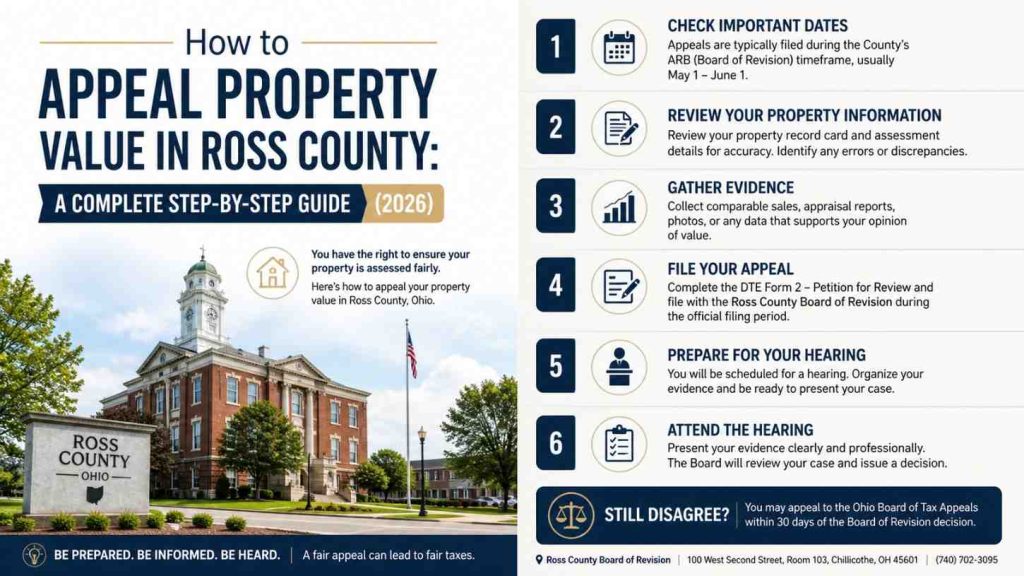
Filing your appeal is the official start of the process. In Ohio, this is done by submitting a Complaint Against the Valuation of Real Property (DTE Form 1) with the Ross County Board of Revision.
Critical Deadline
Your appeal must be filed by March 31 of the year following the tax year you are disputing. Missing this deadline means you must wait until the next tax year to file. Mark this date on your calendar as soon as you decide to appeal.
📌 How to Appeal Property Value in Ross County Online
Ross County has been expanding its digital services to make it easier for property owners to file and manage their appeals. To appeal property value in Ross County online:
- Visit the Ross County Auditor’s official website.
- Look for the Board of Revision or Property Value Appeal section in the menu.
- Download DTE Form 1 (Complaint Against the Valuation of Real Property) directly from the site or from the Ohio Department of Taxation’s website.
- Complete the form with your name, parcel number, current assessed value, and the value you believe is correct.
- Attach supporting evidence (appraisal, comps, purchase documents) as PDF attachments if submitting electronically.
- Submit via the portal or send by email to the auditor’s office if an online submission system is available — contact the office directly at (740) 702-3080 to confirm current online filing availability.
🏢 How to File In Person or By Mail
- Get DTE Form 1 from the Ross County Auditor’s office at 2 N. Paint Street, Suite F, Chillicothe, OH 45601, or print it from the Ohio Department of Taxation website.
- Complete all required sections — property owner name, address, parcel number, reason for complaint, and your opinion of value.
- Attach your supporting evidence — include copies (not originals) of your appraisal, comps spreadsheet, purchase documents, and photos.
- Sign and date the form — unsigned forms are invalid and will be rejected.
- Submit by mail or in person to the Ross County Auditor’s office before the March 31 deadline. If mailing, use certified mail with return receipt so you have proof of timely filing.
- Request a confirmation receipt when filing in person, or keep the certified mail receipt if mailing.
| Filing Method | Where to Submit | Deadline | Confirmation |
|---|---|---|---|
| In Person | 2 N. Paint St., Suite F, Chillicothe, OH | March 31 | Ask for stamped receipt |
| By Mail | Ross County Board of Revision, same address | Postmarked by March 31 | Use certified mail |
| Online (if available) | Ross County Auditor’s website portal | March 31 | Email/portal confirmation |
Step 5 – Attend Your Board of Revision Hearing
Once your complaint is accepted, the Ross County Board of Revision will schedule a hearing. This is your opportunity to present your evidence and make your case directly to the board. The BOR in Ohio is typically composed of the County Auditor, County Treasurer, and a County Commissioner (or their designees).
What to Expect at the Hearing
- Hearings are generally informal but official. You will be asked to take an oath before presenting your testimony.
- Present your evidence in a clear, organized manner — walk the board through your comps, appraisal, and any property condition issues.
- The auditor’s representative may present the county’s rationale for the current assessed value and ask questions about your evidence.
- You will have the opportunity to respond to the county’s presentation.
- The entire hearing typically lasts 15–30 minutes for straightforward cases.
- The board will typically notify you of their decision by mail within 30–90 days after the hearing.
Tips for a Successful Hearing
- Arrive early and bring extra copies of all documents — one for you, one for each board member.
- Speak clearly and stick to facts — the board responds to data, not frustration with your tax bill.
- If you hired a licensed appraiser, request that they attend the hearing with you; their expert testimony carries significant weight.
- If you cannot attend on the scheduled date, contact the BOR immediately to request a reschedule — missing your hearing without notice typically results in your complaint being dismissed.
Step 6 – What Happens After the Board of Revision Decision
After your hearing, the Board of Revision will issue a written decision. There are three possible outcomes:
- Full Reduction: The BOR agrees with your opinion of value and reduces your assessment accordingly. Your future tax bills will reflect the lower assessed value, and you may receive a refund or credit for any overpayment in the current year.
- Partial Reduction: The BOR agrees that your assessment was too high, but sets the new value at a point between your request and the original assessment.
- No Change: The BOR finds insufficient evidence to support a reduction and upholds the current assessed value.
If you disagree with the BOR’s decision, you have the right to appeal further to the Ohio Board of Tax Appeals (BTA) within 30 days of receiving the BOR’s decision. From there, further appeals to the Ohio Court of Appeals and Ohio Supreme Court are also possible, though these steps are rarely necessary for residential property cases.
Should You Hire a Fair Appeal Property Tax Company?
Many property owners wonder whether they should hire a professional — often called a fair appeal property tax company or property tax consultant — to handle their appeal. This can be a worthwhile investment in certain situations.
When to Consider a Professional Property Tax Appeal Service
- Your property is a commercial or industrial building with a complex valuation.
- Your potential tax savings are significant (generally $1,000+ per year) and justify the cost of professional representation.
- You lack the time or confidence to research comparable sales, prepare documentation, and attend hearings.
- Your prior attempt to appeal on your own was unsuccessful.
- You own multiple properties in Ross County and want a systematic approach across your portfolio.
How These Companies Typically Work
Most fair appeal property tax companies work on a contingency fee basis — meaning they charge a percentage of your first year’s tax savings, with no upfront cost to you. This aligns their incentives with yours: they only get paid if they successfully reduce your taxes. Common fee structures range from 25% to 50% of the first year’s savings.
Before hiring any company, verify their credentials, ask for references from Ross County property owners they’ve represented, confirm they are licensed in Ohio, and read the contract terms carefully — especially any fees charged even if the appeal is unsuccessful.
Ross County Auditor, Recorder & Related Resources
Navigating a property value appeal in Ross County means working with several county offices. Here is a quick overview of the key resources available to you.
Ross County Auditor
Ross County Recorder
The Ross County Recorder maintains official records of property deeds, mortgages, liens, easements, and other instruments that affect real property. If you need to confirm the legal owner of a parcel, review the deed for your property, or look up encumbrances that might affect your appeal, the Recorder’s office is your resource. The Recorder’s office also provides public access to these records online and in person at the Ross County Courthouse.
Exemptions and Credits That Can Reduce Your Ross County Property Tax
In addition to appealing your value, check whether you qualify for any of these programs that can independently reduce your Ross County property tax burden:
- Homestead Exemption: Available to qualifying senior citizens (age 65+), disabled persons, and surviving spouses. Reduces the taxable value of your home by $25,000.
- Owner-Occupancy Credit: A 2.5% reduction on the taxes on your primary residence — automatically applied if you live in the property as your main home.
- CAUV Program: If you own farmland in Ross County, agricultural land may qualify for reduced valuation based on its use for farming rather than market value.
- Veterans’ Exemption: Qualifying disabled veterans may be eligible for additional property tax reductions under Ohio law.
Key Contacts at a Glance
| Office | Role | Contact |
|---|---|---|
| Ross County Auditor | Property valuations, tax calculations, Board of Revision | (740) 702-3080 |
| Ross County Recorder | Deeds, mortgages, official property documents | Ross County Courthouse |
| Ross County Treasurer | Tax collection, payment plans, delinquent taxes | Ross County Courthouse |
| Ohio Board of Tax Appeals | Appeals beyond the county BOR level | bta.ohio.gov |
Frequently Asked Questions
Q: What is the deadline to appeal property value in Ross County?
The deadline to file a complaint with the Ross County Board of Revision is March 31 of the year following the tax year you are disputing. For example, to appeal your 2026 tax year assessment, you must file by March 31, 2026. Complaints received after this date are generally rejected and must wait until the following year.
Q: How do I appeal property value in Ross County online?
You can begin the process online by downloading DTE Form 1 (Complaint Against the Valuation of Real Property) from the Ohio Department of Taxation website or the Ross County Auditor’s website. Some counties in Ohio allow electronic submission of the complaint form with attachments — contact the Ross County Auditor’s office directly at (740) 702-3080 to confirm current online submission availability. You may also file in person or by certified mail.
Q: How does the Ross County property tax appeal process work?
The process involves five main steps: (1) verify your current assessed value using the Ross County Auditor property search tool, (2) gather evidence that your home’s market value is lower than assessed, (3) file DTE Form 1 with the Board of Revision by March 31, (4) attend a hearing before the three-member Board of Revision, and (5) receive a written decision — then appeal further to the Ohio Board of Tax Appeals if necessary.
Q: How do I search for property records using the Ross County Auditor Property Search?
Visit the Ross County Auditor’s official website and click on the Property Search option. You can look up records by property address, parcel number, or owner name. The Ross County property search by name feature lets you find all properties associated with a specific owner — useful if you own multiple parcels or want to research comparable properties in your neighborhood. The search tool provides current assessed value, tax history, property characteristics, and ownership information.
Q: What is the difference between the Ross County Auditor and the Ross County Recorder?
The Ross County Auditor is responsible for assessing property values, calculating property taxes, administering tax exemptions, and processing Board of Revision appeals. The Ross County Recorder handles official recording of legal documents related to property — including deeds, mortgages, liens, and easements. If you’re appealing a property value, you work primarily with the Auditor. If you need to verify ownership history or review deed documents, you work with the Recorder.
Q: Is a professional “fair appeal property tax company” worth hiring for a Ross County appeal?
For most residential property owners, a self-represented appeal — especially one supported by a licensed appraisal or solid comparable sales data — is entirely sufficient and far less expensive than hiring a professional firm. A fair appeal property tax company makes more sense for high-value properties, commercial real estate, or complex situations where the potential savings justify the contingency fee (typically 25–50% of the first year’s tax savings). Always verify the company’s credentials and track record in Ohio before signing any agreement.
Q: How do I find my Ross County property tax bill or payment history?
Your Ross County property tax information, including current bill amounts and payment history, is available through the Ross County Auditor’s website using the property tax search tool. Enter your address or parcel number to pull up your full tax record. You can also contact the Ross County Treasurer’s office, which handles tax collection and can provide payment history, confirm receipt of payments, and discuss payment plan options if you’re behind on taxes.
Q: Can I appeal if my home’s assessed value went up after a reappraisal?
Yes, absolutely. A county-wide reappraisal (which happens every six years in Ohio, with a triennial update at the midpoint) often triggers significant changes to assessed values. If your value increased and you believe the new value is too high relative to actual market conditions, you have the right to appeal during the standard filing window. Many property owners successfully challenge values set during reappraisal years by presenting recent comparable sales data or an independent appraisal.
Q: What happens if I miss the March 31 appeal deadline in Ross County?
If you miss the March 31 deadline, your complaint for that tax year will not be accepted by the Board of Revision. You must wait until the next filing period opens (January 1 of the following year) and file before the next March 31 deadline. There is very limited ability to get deadline extensions, so it is critical to file on time. If you believe you had a legitimate reason for missing the deadline, consult with a property tax attorney about any possible remedies.
One of the smartest moves any homebuyer can make before placing an offer is running a quick check through the Ross County Auditor Property Search portal. This tool pulls up the full parcel record for any property in Ross County, Ohio, showing you the official square footage on file, the ownership history, recent sale prices, and whether there are any outstanding tax issues attached to the property. In many cases, buyers discover discrepancies between what a listing says and what the auditor has on record, and catching that early gives you real leverage during negotiations. It takes less than five minutes to run a search, and it is completely free to use. Before your next showing or before you sign anything, [take two minutes to run the numbers here (link)].
This article is intended for general informational purposes only and does not constitute legal or tax advice. Property tax laws and procedures can change. Always verify current deadlines and procedures directly with the Ross County Auditor’s office or a licensed Ohio property tax professional before taking action.


